Module 1 -- Calculus (Integration)
Index
Class 12 level recap
- Integral Calculus Recap
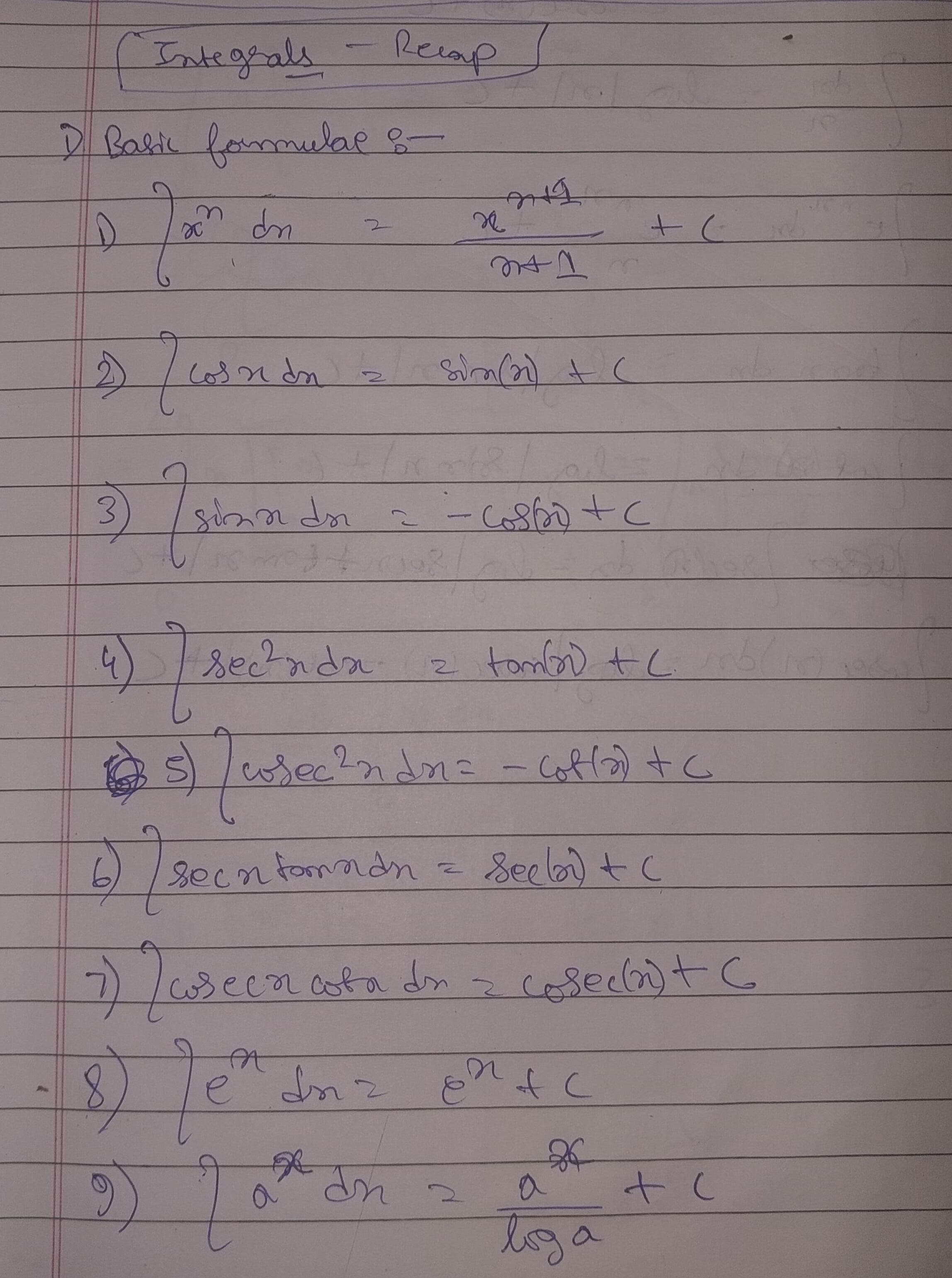
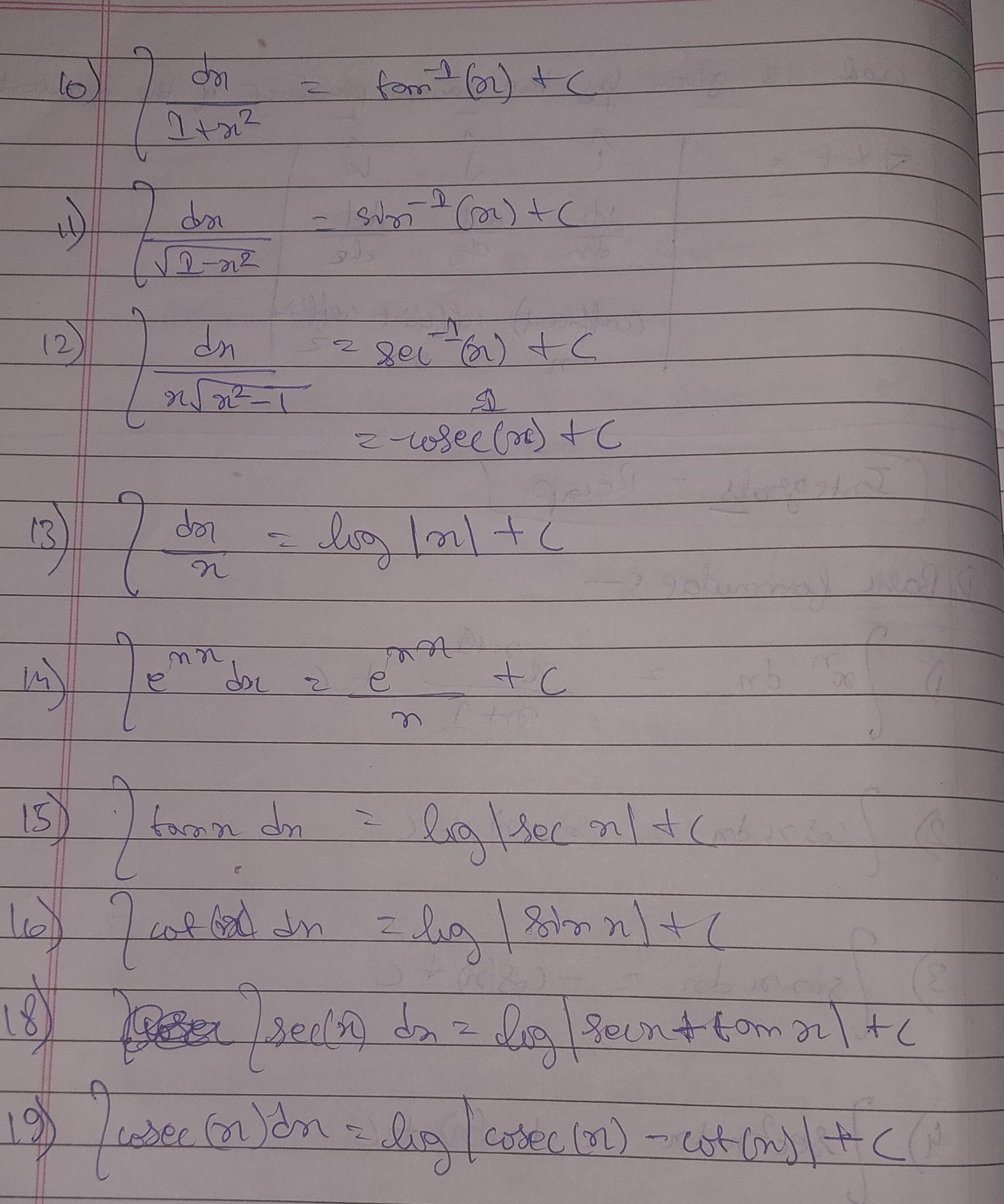
- Basic Integral Formulae
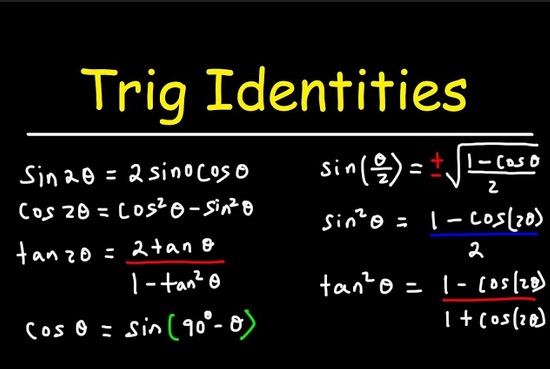
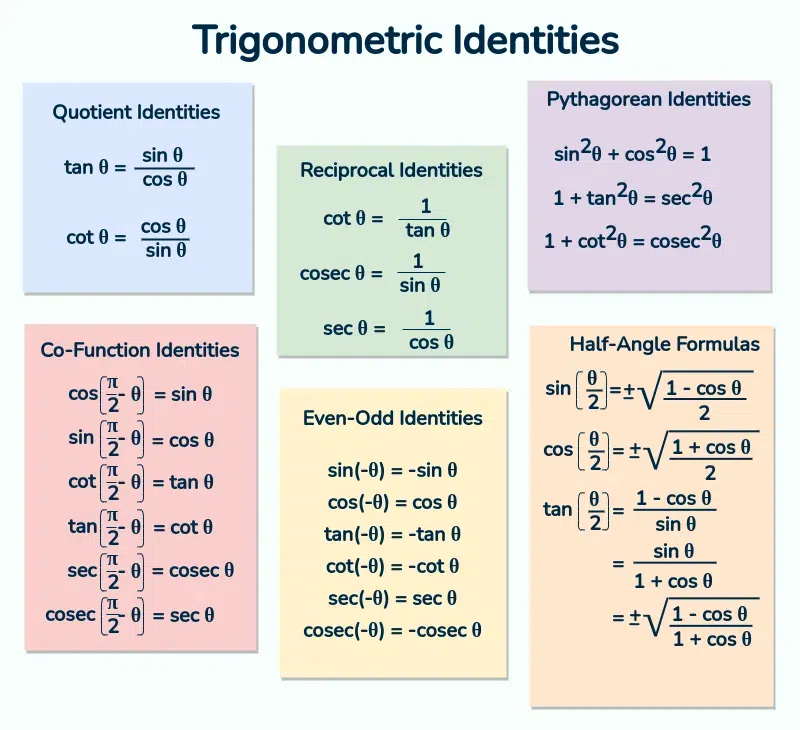
- Some basic trigonometric identities
- Methods of integration
- 1. U-substitution
- 2. Integration by Parts -- The easy method.
- 3. Integration by partial fractions -- An easy method
College Stuff (Calculus - 1)
- Evolutes and Involutes
- 1. Indefinite vs Definite Integrals
- 2. Even and Odd Functions (Symmetry Rules)
- 3. Improper Integrals
- Applications of definite integrals to evaluate surface areas and volumes of revolutions
- DEFINITE INTEGRALS — MASTER ALGORITHM
- Area under Curves
- Volumes of Revolution
- 1. Disk Method (When there is no hollow region)
- 2. Washer Method (When there is a hollow region)
- Gamma Functions
- Beta Functions
Integral Calculus Recap
Taken from Integral Calculus
A problem well defined, is a problem half solved -- Charles Kettering
The above link points to a full comprehensive recap of class 12 recap. Watch it only if you have time.
Basic Integral Formulae
Some basic trigonometric identities
https://www.youtube.com/watch?app=desktop&v=m1OitPmkydY
https://www.geeksforgeeks.org/trigonometric-identities/
https://www.geeksforgeeks.org/trigonometry-table/
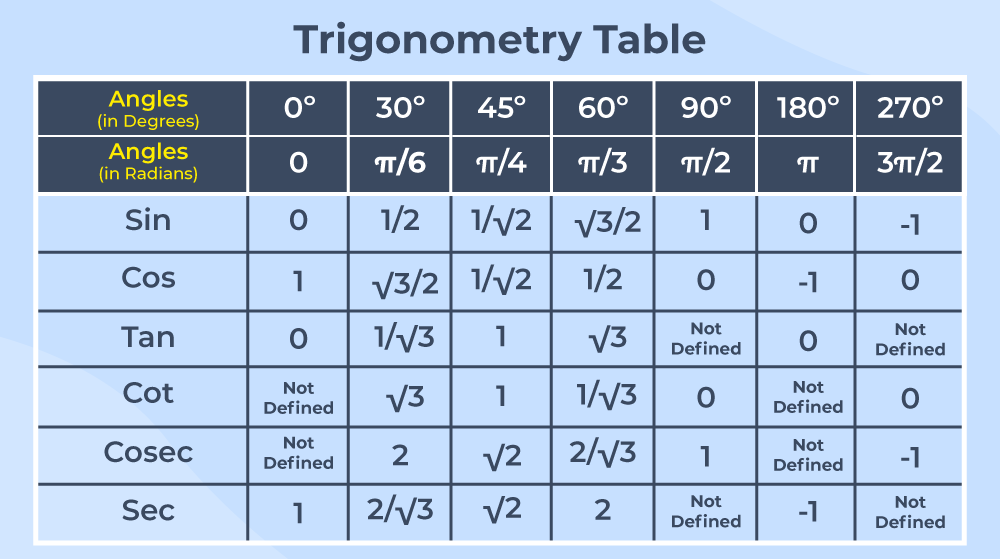
Methods of integration
1. U-substitution
So let's say we have an integral
To solve this using u-substitution, we need to:
- set
. - Differentiate both sides
- So, we get : $${dx} = g'(t).dt$$
And then we replace the value ofand in the original equation to get:
Example 1 :
Let us set
And thus we replace
or , $$\frac{-cos(mx)}{m} + C$$
Example 2
Let $$1+x^2 = t$$
or $$\implies 0 + 2x = \frac{dt}{dx}$$
or, $$2x dx = dt$$
Replacing this in the original equation,
or ,
2. Integration by Parts -- The easy method.
https://www.youtube.com/watch?v=2I-_SV8cwsw&list=PLF-vWhgiaXWM7Iri0t_AjBfv51tF28PEy&index=2
This is called the D-I method. Differentiate-Integrate. (also known as the LIATE method)
Example 1.
So let's say we have this integral here :
We need to make a small table.
| Sign | D | I |
|---|---|---|
The D column represents differentiation and I column represents integration.
Now we choose each term to be either differentiated or integrated.
Here the easy choice seems to differentiate
| D | I |
|---|---|
Now we continue the respective operations on both sides for a while.
| Sign | D | I |
|---|---|---|
| + | ||
| - | ||
| + | 2 | |
| - | 0 |
Each column having alternating signs.
What to differentiate and what to integrate?
- Inverse trigonometric functions (like
, ) — differentiate these if present. - Logarithmic functions (like ln(x)) — differentiate these if present.
- Algebraic functions (like
, , constants) — differentiate these if no inverse or logarithmic terms are present. - Trigonometric functions (like
, ) — differentiate these if there are no inverse, logarithmic, or algebraic terms to use. - Exponential functions (like
, ) — these are typically integrated as a last choice.
When to stop the operations:
- If the column of D reaches
0. - If the products of a row (product of both the value of D and I) can be integrated.
- If any the products of any row (product of both the value of D and I) result in the original integral.
So here we see that the column of D has reached 0.
So we multiply downwards, diagonally, along with each respective sign, and write them together for the final answer.
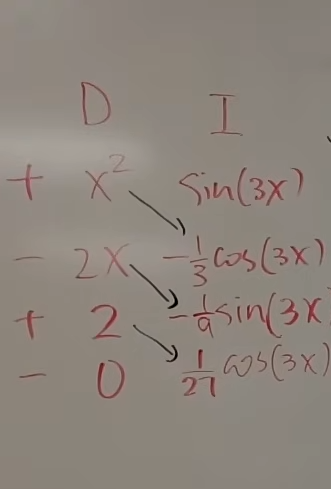
Like this.
So the final answer becomes,
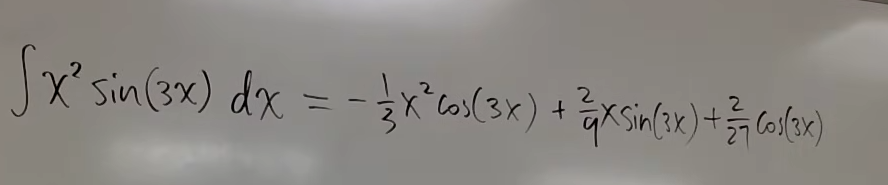
Example 2
Let's say we have another integral
Example 3:
Let's say we have another integral, $$e^x.sin(x)dx$$
Remembering our rules, we differentiate
So ,
| Sign | D | I |
|---|---|---|
| + | ||
| - | ||
| + | ||
| In the third row we see that our original question has appeared. |
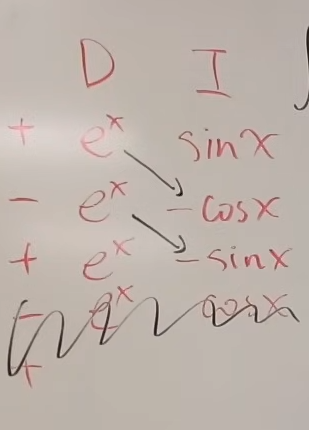
So we stop the operations and write diagonal products first.
or $$2\int{e^x.sin(x)dx} = e^{x}.[sin(x)-cos(x)]$$
or, $$\int{e^x.sin(x)dx} = \boxed{\frac{e^{x}.[sin(x)-cos(x)]}{2}}$$
3. Integration by partial fractions -- An easy method
This method can only be applied if the denominator can be factorized into linear factors
or that in denominator power of
Example 1
So let's say we have an integral :
We can see that it's denominator is in the form of a product of linear factors.
So the way to tackle this, is to take one term at a time.
We first select
Equate this term to 0. We get
Now we apply this value back in the original equation, but there's a twist.
We modify this part of the process by removing the selected term from denominator, but instead placing it in the form of a natural log (log or
- So, for
or $$\frac{-ln(x-1)}{6}$$
2. For
or $$\frac{2(-2) - 1}{(-2-1)(-2-3)}ln(x+2)$$
or $$\frac{-5.ln(x+2)}{15} = \frac{-ln(x+2)}{3}$$
3. For
or $$\frac{2(3) - 1}{(3-1)(3+2)}.ln(x-3)$$
or $$\frac{5.ln(x-3)}{10} = \frac{ln(x-3)}{2}$$
Finally we put all the obtained terms together along with their signs.
as our complete answer.
The given video link has another example on this.
Evolutes and Involutes
Evaluation of definite and improper integrals
1. Indefinite vs Definite Integrals
Indefinite Integral
Indefinite Integral (the integral we are used to by default)
- Reverse of differentiation
- Gives a function
- Always include
Definite Integral
An integral which has defined specific upper and lower limits.
- Gives a number
- No
(constants cancel) - Represents net area
2. Even and Odd Functions (Symmetry Rules)
Odd Function
Examples of such odd functions:
Reason: Areas cancel.
For dissimilar limits:
Even Function
Examples:
Reason: Graph is symmetric about y-axis.
For dissimilar limits:
3. Improper Integrals
An improper integral is a definite integral that extends the concept of integration to cases where the interval of integration is unbounded (infinite) or the integrand has an infinite discontinuity.
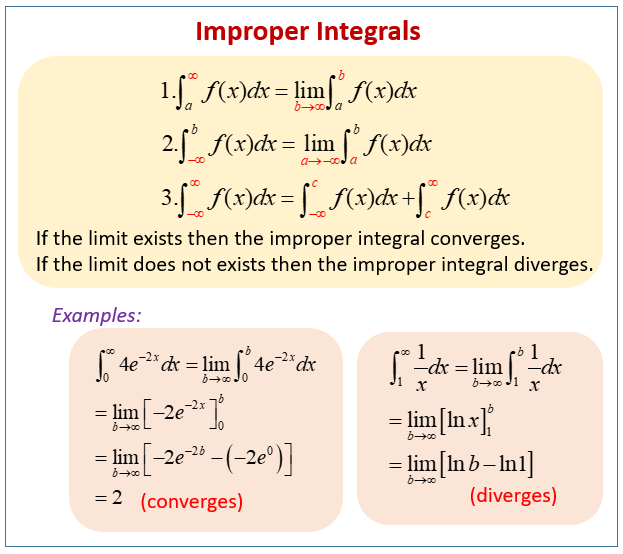
The Case of Infinity
For:
or
The integral:
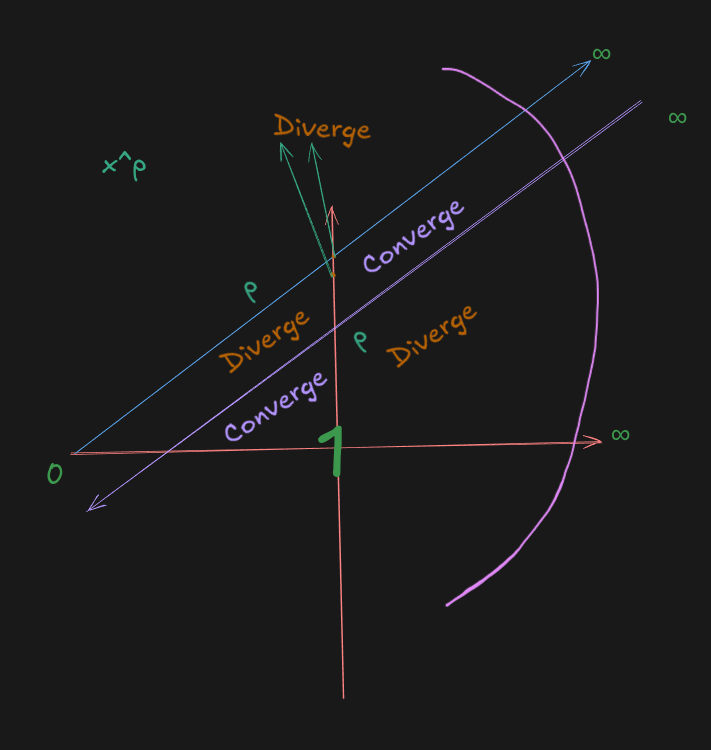
- Converges if
- Diverges if
Key idea: If
integrated. If
Powers even as close to 1 as:
will converge, because that tiny extra power makes the function shrink just fast enough.
However the moment
Example:
Exhibit A:
Exhibit B:
Near-Zero Case
For:
or
The integral:
- Converges if
- Diverges if
Key idea: If
integrated. If
Powers even as close as
The boundary is sharp.
Example:
Exhibit A:
or:
or:
Exhibit B:
5. Why Conditions Flip
| Location | Condition for Convergence |
|---|---|
| Near |
( |
| Near |
( |
At
At
Practice examples for the evaluation of definite and improper integrals.
1. Even and Odd Functions
(A)
Since
(B)
(C)
2. Improper Integrals -- The Case of Infinity
(A)
Here:
So the function will converge.
(B)
Since
The function diverges.
The value is:
(C)
Since
The function converges.
3. Improper Integrals -- Near Zero
(A)
Here,
(B)
Here,
Value:
(C)
Since
I am not going to solve this one, since the concept is already clear at this point.
Applications of definite integrals to evaluate surface areas and volumes of revolutions
Before we proceed, let's sum up definite integrals in one master algorithm
DEFINITE INTEGRALS — MASTER ALGORITHM
We separate everything into three layers:
- Orientation
- Symmetry (Parity)
- Sign / Area Type
PART 1 — ORIENTATION RULE (Always Check First)
Rule:
or
(limits were swapped manually here).
When to use:
- Whenever limits appear reversed.
- Whenever you swap limits manually.
When NOT to use:
- If limits are already in increasing order.
This has nothing to do with symmetry or sign.
It is purely about direction.
PART 2 — SYMMETRY / PARITY RULE (Only When 0 is Structurally Present, i.e present among the limits)
Is interval symmetric around 0?
If yes → use parity.
If no → ignore parity.
or,
Trigger condition:
- Interval is
, or - You are converting
to
Odd Function
Examples of such odd functions:
Even Function
Examples:
PART 3 — SIGN ANALYSIS (Determines Area Sign)
This determines whether the integral is:
- Positive
- Negative
- Zero
Ask:
Is function positive, negative, or changing sign?
This determines:
- Net area sign
- Whether splitting is needed
- Whether absolute value is needed
This is done is as follows:
Suppose we have three range brackets (or zeroes):
Let's say from
And we get the zeroes as:
The rule to test whether the function
- Always check with values between the ends of the bracket.
In the case of zeroes where you cannot find any middle value, you can use either end, like for example
However in the case of the bracket of
So, we can test if the function
Area under Curves
Are we asked for:
- Net area? → use integral normally.
- Total/geometric area? → integrate absolute value.
1. Net Area (Standard Definite Integral)
This calculates:
Signed area.
- Area above x-axis → positive.
- Area below x-axis → negative.
- Opposite sides cancel.
Odd symmetry cancellation happens here.
2. Geometric Area (Total Area)
This calculates:
Total physical area.
Everything becomes positive.
No cancellation.
🔵 When To Split the Integral
Split when:
- The function changes sign in the interval.
- You are calculating geometric area.
- The interval crosses 0 and you want symmetry benefits.
Example:
Quick Summary Table
| Situation | Tool |
|---|---|
| Limits reversed | Orientation rule |
| Interval symmetric around 0 | Parity |
| Interval ordinary | Sign analysis only |
| Asking total area | Use absolute value |
| Function crosses x-axis | Split integral |
Example
Let's say we have:
We have to find the:
- Net Area
- Geometric Area
For Net Area
The limits go from -3 to 3, so the integral has to be split:
Now we solve:
This could also have been directly solved by just:
For Geometric Area
For the integrand,
Set
Thus
So we going from
The function would be:
So, for any
For the first bracket,
For the second bracket,
For the third bracket:
So the function is positive for all three range brackets
So the geometric area would be:
We can technically ignore the middle bracket of
Solving these integrals,
Thus, the net and geometric area are the same.
Practice Problems
1. Find net and geometric area of
Net area =
For geometric area,
Setting,
Then we split the integral:
At:
, , , , .,
So, the function is negative between
So, the geometric area:
2. Find the net and geometric area of
First, we split the integral:
Both are even functions, so by rule of parity:
Now, for the geometric area:
The limits go from
Now, setting
So the zeroes are:
At:
, , ,
So the function is positive for the range brackets of
Now, we will split the integral accordingly:
Volumes of Revolution
This is where definite integrals stop being just “area under a curve” and start becoming 3D geometry.
We revolve a curve around an axis → it sweeps out a solid → we compute its volume using integration.
There are two primary methods you must master:
- Disk / Washer Method
- Shell Method
1. Disk Method (When there is no hollow region)
Situation:
You rotate a curve around an axis and it creates a solid disk (like stacking coins).
If a function
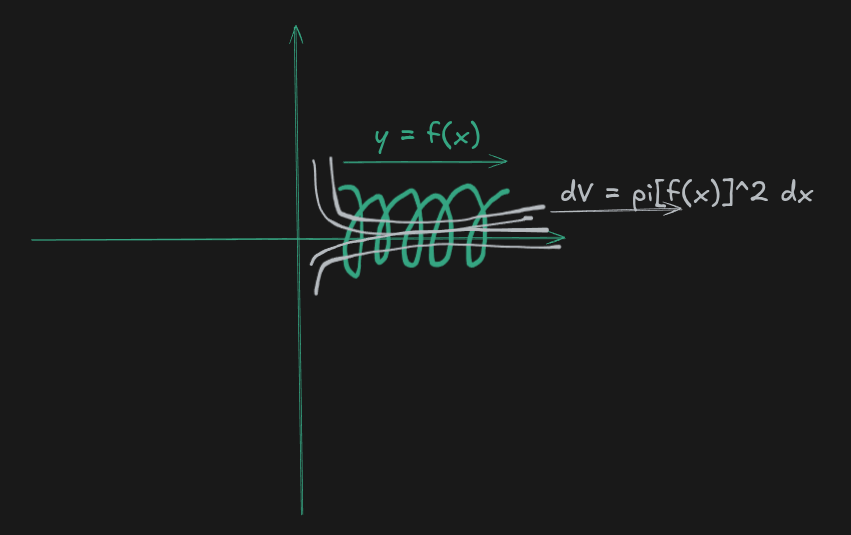
Why is function squared?
Because:
- At each x, the radius =
- Area of circular cross-section =
.
So, a small volume element will equal:
Then we can integrate it to find the volume.
Example 1.
Find volume formed by rotating:
from
Step 1: Find radius.
At each
Step 2: Apply formula:
2. Washer Method (When there is a hollow region)
Now suppose you rotate the region between two curves:
and
with
You get a hollow solid, like a washer.

The formula for the volume is:
where:
= outer radius = inner radius
WASHER METHOD — PURE ALGORITHM
We assume:
- Region between two curves
- Rotated about a horizontal or vertical line
STEP 1 — Identify Axis of Rotation
Is it:
- y = 0 (x-axis)?
- x = 0 (y-axis)?
- y = k ?
- x = k ?
Write it down clearly.
Everything depends on this.
STEP 2 — Decide Variable of Integration
If axis is horizontal (like y = something):
→ Use vertical slices
→ Integrate with respect to dx
If axis is vertical (like x = something):
→ Use horizontal slices
→ Integrate with respect to dy
(Exam shortcut: washers use slices perpendicular to axis.)
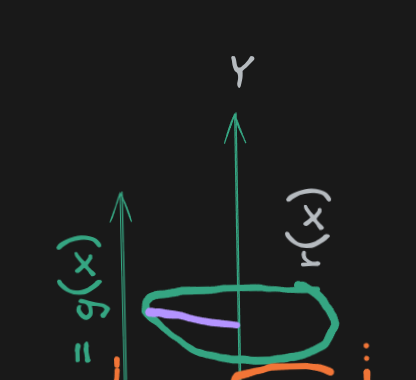
STEP 3 — Identify Outer and Inner Radius
Radius = distance from axis.
Always compute distance using:
Then:
- Outer radius = farther curve from axis
- Inner radius = closer curve to axis
Do NOT think “which function is bigger.”
Think “which is farther from axis.”
STEP 4 -- Apply Washer Formula
Where:
- R = outer radius
- r = inner radius
Gamma Functions
What is it?
The Gamma function is an extension of the factorial to all real numbers, including fractions.
Formally defined as:
-
The
term forces convergence despite the infinite upper limit — it kills the function fast enough as -
Defined for all n > 0
The Reduction Formula
This is the core property. Every Gamma value connects to the previous one by simple multiplication — same unwinding pattern as a factorial.
So Gamma is the factorial function, shifted by 1:
- Γ(5) = 4! = 24
- Γ(6) = 5! = 120
⚠️ Watch the shift — Γ(5) = 4!, not 5!
Base Values
Half-Integer Values
Derived using the reduction formula starting from
| n | |
|---|---|
Pattern:
- Numerator: 1, 1, 3, 15 → each multiplies by the next odd number
- Denominator: 1, 2, 4, 8 → powers of 2
💡 If you blank in the exam, just re-derive on the spot using the reduction formula. Takes 20 seconds.
Beta Functions
What is it?
A function of two inputs that measures a weighted interaction between two exponents.
- Limits are 0 to 1 (unlike Gamma which goes 0 to ∞)
- Two parameters m and n
Key Properties
Symmetry:
Bridge Formula:
This connects Beta back to Gamma. Almost every exam question uses this.
⚠️ Denominator is Γ(m+n) — add the arguments FIRST, then take Gamma. Not Γ(m) + Γ(n).
Trigonometric Form
Which means:
since:
Algorithm for Trig Integrals
- Read off p and q from the powers of sin and cos
- Compute m = (p+1)/2 and n = (q+1)/2
- Extend the half-integer Gamma table as far as needed using Γ(n+1) = n·Γ(n)
- Plug into bridge formula
- Let √π cancel — keep everything as pure fractions, never decimals
- Simplify fraction to final answer
Worked Example
- p = 5, q = 4
- m =
, n = - Γ(3) =
- Γ(5/2) =
- Γ(11/2) = 9/2 · Γ(9/2) = 9/2 ·
=